

Embedded payment processing: how it works and why it matters for vertical SaaS
August 18, 2026

Blog
A lot of platforms still send merchants somewhere else to get paid. A separate payment provider, log into another system, or pull out a card reader that doesn’t work with your software.
That's changing fast.
With embedded payment processing, accepting payments isn’t bolted on anymore. It’s part of the platform itself. Merchants onboard, take payments, manage deposits, and track transactions without ever leaving the software they already use to run their business.
For vertical SaaS platforms, it’s a lot more than just a smoother checkout experience for their merchants and end customers. There’s real money already moving through your platform. And embedded payments can help you actually capture it instead of watching it pass through.
Here's how embedded payment processing works, what sits behind the technology, and what it takes to build it.
What is embedded payment processing?
Embedded payment processing lets software platforms accept payments without sending merchants to a separate provider. Everything from onboarding and checkout to payouts and reporting happens in one single place.
Think about the software a plumber, dentist, insurance broker, or landscaper uses every day. They schedule jobs, send invoices, and manage customers inside that software. With embedded payments, merchants can take a payment before closing the job, instead of pulling out a separate card reader, logging into a different processor's portal to run the charge, or waiting until they're back at a desk to collect payment at all.
A bolt-on solution usually sends merchants somewhere else to sign up, log in, or process payments. Embedded payments keep the entire payment experience inside the platform, making it feel like a natural part of the product.
How does embedded payment processing work?
The most common way for vertical software platforms to add embedded payments is to work with a modern embedded payment provider.
Merchants can onboard, accept payments, receive scheduled deposits, and view reporting without ever leaving your software. Your platform owns the customer experience, with some payment providers handling compliance, risk management, and fraud monitoring.
Here’s how the typical model works under each area.
The role of APIs and embedded components
Most modern embedded payment providers will provide a combination of APIs and embeddable components. That might include onboarding forms, payment pages, payout dashboards, or digital wallets such as Apple Pay, PayPal and Google Pay.
Embedded payments literally feel like a natural part of your platform. Not a separate service merchants have to learn.
Onboarding and underwriting sub-merchants
When working with a modern embedded payments provider, they’ll usually handle a majority of the merchant onboarding for you.
Underwriting is managed by the payment provider, and approval can happen pretty fast (sometimes a few minutes or days). But the speed comes from the tech and processes behind it, not necessarily from the sub-merchant structure itself, which is important to note.
For platforms onboarding hundreds or thousands of businesses, that speed can make the difference between a merchant activating payments during signup or abandoning the process before they ever accept their first transaction.
And faster onboarding doesn't just improve the merchant experience. It can improve conversion rates by reducing friction during signup.
Acceptance, settlement, and reporting
Once a merchant is live, they can accept card payments, ACH transfers, and digital wallet payments directly inside the platform.
The payment service provider routes transactions through the card networks, settles funds, and manages deposits behind the scenes.
Payment data and transaction reporting flow straight back into your software, so merchants can track sales, deposits, and accounts receivable in one place. No extra dashboards. No separate logins. No jumping between systems.
The platform benefits too. Every transaction generates valuable payment data that can reveal adoption trends, highlight merchants who might need support, and surface problems before they become bigger ones.
Why embedded payment processing matters for vertical SaaS
For your platform, embedded payment processing is a revenue line rather than a convenience feature. Every dollar your merchants process becomes volume you earn instead of volume you hand to a third party. The payments data that comes with it makes lending, banking, and other financial products possible later.
Merchants get a better experience too, which is what drives the adoption.
But for a vertical SaaS platform, it's much bigger than that. Payments become part of your product, creating new revenue opportunities, richer payment data, and another reason for merchants to keep coming back.
A unified experience for merchants
Merchants don't want to jump between different tools just to get paid. When scheduling, invoicing, checkout, and payouts all happen in the same platform, getting paid becomes another step in their existing workflow instead of going through a third-party provider they have to manage.
Fewer clicks. One login. No context switching. That kind of experience is easier to adopt because it fits naturally into the way merchants already work.
More revenue for your platform
Every payment processed inside your platform is another opportunity to generate revenue instead of handing transaction fees to a third-party provider. And the opportunity is growing. Platforms that successfully embed financial products have an opportunity to diversify their revenue beyond software sales, while reducing churn at the same time.
For most mid-market and enterprise platforms, embedding payments shows up in the fundamentals: unit economics improve, cash flow gets healthier, and lifetime value goes up. Andreessen Horowitz puts the increase at two to five times revenue per customer for SaaS businesses that add fintech.
The problem? Many platforms still treat payments like a utility instead of a growth strategy. In fact, 70% of non-financial platforms still don't recognize payments' full potential as a driver of growth.
Higher retention and stickiness
When payments live alongside scheduling, invoicing, reporting, and customer management, your platform becomes more than a piece of software. It becomes part of how merchants get paid.
That changes the relationship. If a merchant wants to switch providers, they aren't just replacing one tool. They're moving payment data, transaction history, deposits, customer workflows, and the processes they've built around them.
That's why embedded payment processing does more than create a new revenue stream. It gives merchants another reason to stay, while making your platform a bigger part of their everyday operations.
Embedded payments vs integrated payments
The terms embedded payments and integrated payments are often used interchangeably, but they aren't quite the same thing.
- Embedded payments are fully native, white-labeled experiences built directly into your platform. Merchants onboard, accept payments, and view reports without ever leaving your environment.
- Integrated payments connect your software to a third-party provider, usually through an API. You can usually bring some payments functionality into your core software, like pre-filling invoice amounts or displaying payments data in a report, but it’s labor-intensive to build and maintain. To put it simply, it’s clunky.
Here’s a quick and straightforward breakdown of what you get with each.
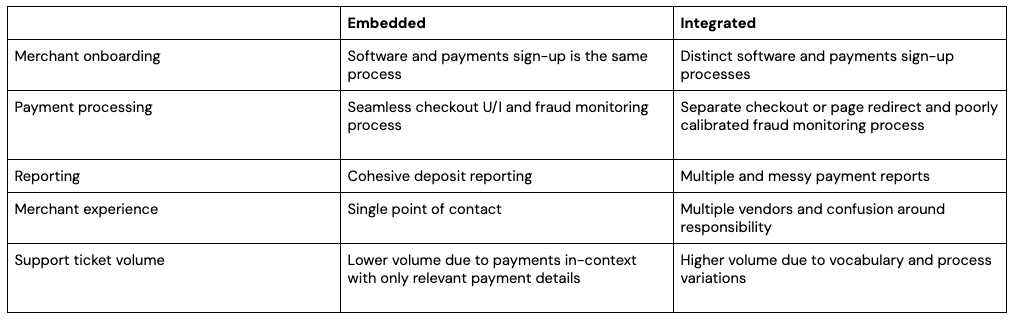
With integrated payments, you're connecting to someone else's payment experience. With embedded payments, you're creating your own. That gives you more control over branding, pricing, merchant relationships, and the customer journey.
The more of the onboarding, checkout, reporting, and deposits that happen inside your platform, the more embedded and better your payments experience becomes for everyone.
How to add embedded payment processing to your platform
There isn't one way to embed payments. Which route fits depends on how much control you want, how fast you need to launch, and how much operational weight your team can carry.
Becoming a registered PayFac
Register as a payment facilitator, and the master merchant account is yours. Merchants join as sub-merchants underneath it, and everything sitting behind that account becomes your responsibility: underwriting, payment security compliance, risk management, chargeback processing, and fraud monitoring.
You get near-total control over pricing and the merchant experience in exchange. You also get a registration process that runs 12 to 18 months and a standing need for payments operations and compliance people on staff. The hidden costs of registering tend to surface after the decision is made rather than before it.
PayFac-as-a-Service
You connect through an API instead of building the stack, and most payments partners will manage underwriting, compliance, and risk behind the scenes.
You keep the merchant relationship and the payments revenue that comes with it. What you hand over is the operational load, and that trade is why most vertical SaaS platforms choose this route over registering.
Payments that scale alongside your platform
The platforms that win on adoption treat payments as part of the product. Not a feature sitting beside it. Merchants don’t need to think about where the payment happens. They never leave the software they already work in.
Merchants receive a workflow without gaps, your platform earns on volume it used to pass straight through, and the infrastructure underneath scales as both of you grow.
Rainforest helps vertical SaaS platforms process more volume at higher margins, without taking on risk or compliance overhead. You keep full control of merchant data, relationships, and pricing. We handle KYC, PCI, and fraud monitoring.
Frequently asked questions about embedded payment processing
What is embedded payment processing?
Embedded payment processing lets merchants accept payments without leaving the software they're already using. Instead of sending customers or merchants to a separate payment provider, everything from onboarding and checkout to payouts and reporting happens inside the platform. It's one of the most common forms of embedded financial services, helping SaaS platforms create a smoother customer journey while opening up new ways to monetize payments.
Does embedded payment processing add risk or compliance burden for the platform?
Not necessarily. If you build through a PayFac-as-a-Service provider like Rainforest, the platform can offer embedded payments without taking on the full operational burden itself.
Rainforest manages KYC, PCI, fraud monitoring, and risk management. Rainforest is responsible for merchant underwriting, which means we absorb the losses. Fraud-driven chargebacks can be reduced through built-in tools like 3DS.
Share this article
Subscribe to our blog
Be the first to hear about new content

Related articles
View all articles

.png)
.png)
Get started today.
Boost revenue with Rainforest
Get Started

Legal

© 2026 Rainforest Pay, Inc
